четверг, 9 декабря 2010 г.

As Der paintball played in the swamp drowned, eaten kebab

Riddle: A lot of days off, but not New Year's holidays. The correct answer - the May holidays. According to tradition it was in May, our country begins to Shashlyk season. That Der this year decided to continue its tradition of the May rallies in nature. True, this time the meeting was to be held originally. The mind still won perverse desires of members Der. Therefore, the banal scheme "to eat all that grunt, drink all that off, foams or not washed off with clothes," was rejected. Rally had to pass with meaning. And the meaning of sports. We decided to play paintball.
The day before the rally

Initiative at all times been penalized. It was necessary to keep this in mind, when I put forward a proposal to use "self-made" kebab. Once he suggested, if you please yourself and prepare.

Fortunately for those who are responsible for the gathering of food and alcohol, has its own bonuses. So thanks Rosichi we do not have to go to the market for meat on foot. We went there in the belly of the Japanese iron horse. Saying "we" I mean myself, Rosichi, Kovad and Hans. They decided to monitor me. In the market we are in caring hands of traders from the southern borders of the country. With their help, managed to buy meat, vegetables and any other useful garbage. Kovad even some cheese with a "noble" mold bought it, but refused to watermelon, recently torn from a bed. " So in our history "blue blood" of mold and its ten generations of noble ancestors defeated the Uzbek melon.

Then, all purchases were shipped to my home, where they quietly and lay up at night. And on the night I realized that I cook alone is the amount of food is not difficult. This ohrenet as hard. An hour later, I earned a corn on the knife, and by dawn left me insane. I became a parody of Kai. Ice cubes in the refrigerator was not found, so was the word from the bulbs, which have been around plenty....
 

In the morning everything that could and could not cook, we went into the car Rosichi. There also fell and the car Troopers joined by Shaman. In this composition, we went to a meeting with peytnbolom. While sitting in traffic jams mainly addressed the topic with the disappearance of Vibli and ceramics. Visitors to the capital was supposed to meet at the Leningrad station Gore. But he could not find them. We long to decide that the same could happen to them and stopped on a variant of the Roma. According to our version Vibli and Ceramics were greeted at the station a gypsy camp. They were confiscated cell phones and OEGeshnikov instead bears enlisted in concert troupe of gypsies.
"Wear shoes" - they said

The club we went almost up to date. Even stolen Gypsies Vibli and Keram were already in place. After our arrival, the group joined Der instructor. He's a judge. We were given a lecture about safety, told about the rules of the game and showed markers (Marker - weapons that are used in paintball). Then taken to the warehouse, there was given clothes and weapons. We shared by two teams, one of the participants are marked with yellow tape. Well, the desire to play voynushki almost fulfilled....

Now imagine you are such a beautiful fit in Kamke, wearing a mask and with a marker to the playground. Before you kindly pick up the guard. You take a step into the clearing ... and leg to the ankle goes into the dirt. "What kind of garbage?" - You ask. Here I am on the day he could not understand why instead of playing peytbol, I reconstruct the march of German troops on the roads of the Soviet 41-th year. Not even on the roads and fields, on which several times a day drive away a herd of cows. And judging by the smell, the waste of life of these cows immediately and buried. In this case, it happens over several centuries in a row. Play got sick and wanted to kill. First and foremost wanted to kill ethanol. It was he who advised the forum to use as a replacement shoe sneakers. After the murder of Ethanol, I was going to kill himself because he listened and did not take Burtz with removable socks.

While I was planning on serial murders, the foot sinking deeper into the mud. Situation should fix as soon as possible. I took another step, but has made only the fact that the second leg was in a bog captivity. He looked around, hoping to find at least a small piece of dry land. Where are there, everything is already waterlogged before us. Tried to pull the first leg. Partially succeeded. Foot from the mud got out, but the favorite slippers was left in a swamp. Fearing that sandalku can no longer see, I tried to get into her back. A couple of times he missed. But when the sock color has come to resemble the surrounding swamp, return to the sneaker still managed. Now the mud could no longer be afraid. Travel speed immediately increased. I even managed to catch up materyaschihsya comrades. By the way is the only island of land was found just at the position of our team for one of the bunkers. Mentally promised myself not to go to this place, I began testing weapons....

About markers spots and pandas

Marker funny thing. Noticeably lighter than the same airsoft AK-74. But the impact is much stronger than the drive. Sensation from the shot of the original marker. Like and shoot, but we must realize that the damage was limited to spot and bruises. This is if safety observed. Immediately wanted to experiment on humans, but the next Ethanol was not because he played for the Greens. Shooting at people turned out only during the game. But it lasted long. The trigger, I had to click three times. After that, the mask flew something from the "green" and I had to leave the area. Not sure if this was a ball, for traces of the mask is left. But I decided to play it safe and went to the door. Pick this up to the position of our team was really easy. Then interfered with only mud, but now it has been joined and OEGeshniki. It turns out that Der takes no prisoners and wounded were finished. While getting to life-saving nets, I got all five times. And the shot as the one and the other side. As a result, one of the balls, even fell in the ass. In the future, time will be able to wipe the fifth point sfotkat nasty Shrike. When clearing abandoned the "yellow" is the first time swamp the confrontation ended. The event started on ottiraniyu paint. Someone rubbed stains from clothes, the highest with the masks. When all the consequences of the battle have been removed, we returned to the site. The horrors continued.

At this time, no hurry to attack. Do "green" this was a tactical plan, we have the same effect of having even more swamp at a new position. When playing in positional warfare tired, I decided to demonstrate his talent of the great commander. I'm three times in the last Total War'e Paris took! To implement the ideas I decided to use Vibli, whom fate has brought to me by one of the embrasures. In my plan, we should first get to the bunker with Hans, who was slightly ahead. And already from him to move to the middle of the field and shoot it all "green."

Vibli guy was tricky, so to me did not run. But I discovered only when I got to Hans. But found out why all this time, Hans was hanging on a wooden embrasure, as if drunk panda. Simple piece of wood was surrounded by a puddle. Feel warm and fuzzy here could only zavisnuv, resting in the design of hands and feet. Perhaps I too would become panda, if not "zelenozadye. Some sniper managed to get me in the arm. And apart from the "wounded" I was still full of sneakers and water. Losing such a valuable player, "yellow" by itself failed.

After that we took on another clearing. It differed from the first only in the presence of houses. Moorland was exactly the same. If not worse. Here, I honestly tried to hide out in houses and dry off. But the ball flying through windows and doorways, and find me there. In the end we managed to win only once. In that battle the second time I tried to lose the sneakers. After losing several battles, citing fatigue, we decided to score with Hans for the next two games. No longer wanted to play. Thirsty....


About pandas-2

When sports merrymaking ended, people switched to alcohol and kebabs. Shaman traditionally stood at the barbecue, and the others took their places at the tables. Booze took place in a civilized style, as long as Rioter and Tevtus not decided to climb trees. Laurels, Hans-panda did not give them peace of mind. The club immediately found an obstacle course that could pass anybody. True, it took place mostly drunk people, as the band was located at the crown. Rioter and Tevtus were just drunk. They climbed disgusting - no one broke. Well, he broke it himself Rioter something in the air as a split would sit. But at this show and ended...
When climbers returned, booze continued and completed only at night.
Overall the day was lived not in vain. It was fun, scary and dirty. I hope soon be able to rally again. Scare only continued over Moscow rain ...

воскресенье, 5 декабря 2010 г.

Activate the Humble Indie Bundle on Steam

About 6 months ago we tried out a modest promotion called the Humble Indie Bundle. Thanks to everyone's support, we raised nearly 1.3 million dollars for independent video games and charity. There were about 140,000 bundles purchased. While customers can always download the games directly on the Humble Bundle page, the most frequently asked question was "Can I activate my bundle of games on Steam?".
Well, we've been diligently talking to Valve about this, and as of today, we are happy to announce that YES, your Humble Indie Bundle can be activated on Steam! Just go to your Humble Bundle page (click here if you forgot your key) and you should see your unique Steam key listed at the top.

Once you have retrieved your Humble Bundle Steam key, you should be able to follow these steps to activate your games on Steam.

On Mac OS X, it's really easy. Just launch Steam and choose "Activate a Product on Steam" from the menu.
  

Screenshot of the first steps for activating your games on steam.

On Windows, this menu bar will be in the game client window itself. For Linux customers, unfortunately Steam has not announced a Linux client yet.

Just to clarify -- this only applies to customers of the original Humble Indie Bundle which is now closed. However, if you are sad that you missed it, there's something weird happening over here. Hmm, just in time for the holidays...
 

Mafia Wars Heavy Metal Armory Celebration - Build exclusive items for a limited time

Starting today, Zynga is celebrating the Armory in Starting today, Zynga is celebrating the Armory in Mafia Wars with a Heavy Metal Armory Celebration. This event will allow you to collect Tech Plates to build not only new pieces of armor, but also exclusive items, that will only be able to be built during this event.

Over the next 4 days and 12 hours, you'll be able to build in the Armory at twice the rate as normal. You're given a shipment of Tech Plates automatically for starting the event, which will allow you to (in most cases) instantly upgrade your armory to the next level. From there, you need to collect individual pieces of Tech Plates that can be traded in for a variety of items.

The two exclusive items are the Pantheon Tactical Helm, a helmet item that requires 5 Tech plates to build and has 55 Attack and 48 Defense points, with a +5 Attack boost for your overall "character" in the game. The other item is the Crimson Iron Chest Plate, requiring 8 Tech Plates to build. This item offers 49 Attack and 57 Defense points, and gives you a +6 Defense boost.

The easiest way to earn Tech Plates is to post a help request on your wall via the button provided on the Mafia Wars home page. This alerts your friends to the fact that you need Tech Plates, and they can easily send you one for free.

Some of the other new items (not limited time items) that are available to build in the Armory are the Welding Mask (30 Attack and 25 Defense), the Sprinting Shoes (25 Attack and 32 Defense), and the Forearm Guard (38 Attack and 30 Defense). These items take not only the traditional armor parts to build, but also require "Special Parts" to build.

Remember, these time-exclusive items will only be available for the next four days, so make the most of the time available to you and start asking for Tech Plates as soon as you can.

суббота, 4 декабря 2010 г.

Shock and gore: why video games are failing at horror


Think of your favourite ever horror game. Did it give you nightmares? Or at least make you want to keep the hall light on? No? Then it has failed as a piece of horror entertainment.

The term 'horror game' has become something of a misnomer, a generic term applied to any title that serves up lashings of viscera, or the odd ghost or monster. The latest example is Splatterhouse, Namco's furiously gory re-imagining of the old arcade and 16bit console series. This hack-n-slash fest is a cacophony of spraying blood and flying body parts and it makes lavish references to '70s exploitation cinema, '80s slasher films, and the works of HP Lovecraft. But it's about as scary as a Sunday afternoon costume drama re-enacted by Care Bears.

It is not alone. Horror should be a key facet in the video game armoury – the unique element of interaction is seemingly purpose-built to drag us into nightmarish experiences. But, mostly, horror games  are merely blood-soaked adventures or shooters, which borrow the clothes of successful horror movies without ever occupying the body of terror within.

Why?

The first and most obvious explanation is that truly successful horror usually relies on the twisted vision of a single auteur. From James Whale to James Wan, the cinema of terror has been defined by mavericks and weirdos, often working with small crews and using movies to explore their own fears and neuroses. Only William Castle could have made The Tingler, only Wes Craven could have watched Bergman's The Virgin Spring and come up with the tonally bizarre Last House on the Left, and I'm hoping that only Tom Six could have imagined The Human Centipede. These aren't works that would come up through a boardroom discussion on USPs.

In video game development, it is very rare for this sort of singular creative input to make it through the rigorously structured and often painstakingly democratic production process. Within the average 150-person dev team there will be various strata of producers, creative directors, designers and marketers each jostling to impose their own conceptual foibles, while ironing out idiosyncratic design quirks. There are budgetary concerns, too – a mainstream publisher can't risk $30m on one man's nightmarish fancies (in this respect there are similarities with Hollywood, where horror flicks tend to involve specialist independent production companies and smaller budgets). Furthermore, as mainstream game development is still largely a technical rather than artistically-led endeavour, the sort of warped horrors imagined by the likes of Lucio Fulci or Ruggero Deodato are almost certain to be jettisoned in favour of another end-of-level boss, or never entertained at all.

Within these production constraints it's hardly surprising that horror games are mostly about cheap shocks and even cheaper gore: these are the systematic elements of horror most easily producible in a largely egalitarian, highly technical team environment. The ingredients required to make a gamer jump are fairly easily reproducible – you just need sudden unexpected movement and a loud noise. The most famous moment in the original Resident Evil is when the zombie hounds crash through a window as Jill Valentine makes her way gingerly through the Umbrella mansion. The moment takes place in a short corridor – a transitional space which doesn't look or feel like a set-piece location, so we're not expecting anything. It's a basic mechanic designed to exploit very recognisable human reflexes. The early Resident Evil games also made use of expressionistic camera angles to warp and obscure the player's view of their surroundings – and again, this is a well-known cinematic technique. All the designers had to do was sit down and watch the Cabinet of Doctor Caligari. Or any George A Romero movie.

Meanwhile, in the video game space, gore is cheap. In a film, an elaborate scene of bloody violence might well cost hundreds of thousands in CGI, prosthetics, stunt work and cinematography. In a game, it's no more or less expensive than any other scene, so it's easy for elements such as tension and subtly to be cast aside in favour of endless disembowelment – hence, games like Splatterhouse and Mad World, which display all the Hitchcockian suspense of a monday morning down at the abattoir. Also, from Mortal Kombat onwards, designers have known that pulling a character's arm off is a great way to entertain the traditional demographic of teenage boys – and pulling a character's arm off is, once again, a technical rather than artistic challenge. And then there's the fact that blood is a useful visual tool: it adds organic movement and matter to a static environment; it contrasts with the standard video game palettes dominated by blacks, greys and browns; and it can be used to break the fourth wall, oozing and spraying across the screen, bringing the player into the action. No wonder we see so much of it (unless we buy our games in Germany).

The problem is, robbed of any kind of psychological depth, these horror mechanisms become empty sideshow tricks within games that are merely gruesome pantomimes. Splatterhouse fails as a horror game because it is not at all scary. But then neither – really – is Resident Evil. They go through the motions, they have monsters and body parts and a few dark ideas, but there's very little substance or meaning behind it all. In comparison, the most memorable horror movies and novels prey on deep-seated collective fears and psychosexual hang-ups. With Carrie, for example, Stephen King meant to explore the fear of female sexuality, rather than the fear of being impaled on falling gym equipment by a telekinetic murderer; and it was a similar fear and disgust that underpinned William Friedkin's masterful treatment of The Exorcist. Psycho and Alien gorge on facets of Freudian theory and the Kleinian concept of the archaic mother. Vampire movies can hint at everything from fears of contamination to the power of the id
.
Games generally don't do this. There are titles that have delivered effective supernatural chills – the Project Zero series, Siren: Blood Curse, Alan Wake – which, by default, summon fears of death and the uncanny. Dead Space, meanwhile, made excellent use of darkness and scary audio effects to ramp up the tension. There may also sometimes be inadvertent moments of symbolic horror – with its vengeful ghost mother, F.E.A.R has an element of what cultural critic Barbara Creed referred to as the monstrous feminine. But there appear to be no established systems of exploring and conveying shared primal fears through games. Silent Hill is often labelled as psychological horror, because it deals more in surreal imagery than in straightforward shocks and monsters – but there's little sense of universality in the demons that stalk the series. In an article on survival horror  for The Idler, Gavin Craig asserts that Silent Hill 2, in which the lead character is haunted by the death of his wife, seems to be built around Freudian notions of psychosexual guilt. Craig also sees the lead antagonist, Pyramid Head as a Jungian archetype – and there's certainly weight to that argument. But Pyramid Head is too obscure, too specific, to be generally scary in the same way as, say, HR Giger's Alien or Frankenstein's Monster, both of which are rife with metaphorical significance.

To me, it's not surprising that the most unsettling games haven't been horror games at all. Rockstar's Manhunt, with its utterly nihilistic premise and remorseless violence is a grimmer game than 100 Splatterhouses crammed into a tourture chamber together. Heavy Rain, meanwhile, is about neglect and remorse and parental duty, and manages to disturb through a series of psychologically challenging mini-games and motifs. And Bioshock, riddled with images of genetic horror and twisted folkloric tropes, is arguably more nightmarish than any Silent Hill title. Interestingly, both Heavy Rain and Bioshock were effectively overseen by auteurs – David Cage and Ken Levine respectively. The weird (though crucially meaningful and recognisable) concepts they were willing to explore may have been smoothed out in a less directorial development environment.

What Heavy Rain also proved was the effectiveness of setting a psychological thriller in a recognisable universe peopled by believable characters. Ethan and Madison are not demon slayers running around a mythological castle swirling gigantic swords at over-sized monsters, they're just regular people. Indeed, one of the singular creative crimes of the mainstream video game industry is its inability to engage with the real world. Of course, there's absolutely nothing wrong with escapist entertainment, but there should be an alternative, and the idea of horror is not being fully exploited until studios begin to consider the ample horrors our own world provides.

But then we probably shouldn't be looking toward mainstream developers for truly terrifying game experiences – just as we wouldn't look toward mainstream movies. The indie community, a place where small teams and lone coders are still free to explore singular horror visions, is making more interesting inroads. Check out the frequently disturbing works of Jonatan Soderstrom or surreal adventure game The Path by Belgian studio Tale of Tales. It could also be that the future of the true horror game is with digital download titles. The monochromatic Limbo by Playdead managed to conjure a true feeling of dread out of its sparse, shadowy landscapes.

These examples are diverse, and you'd have trouble effectively categorising some of them as 'horror'. But they have more to say about fear than games like Splatterhouse ever will.

Xbox 360 is five today (in the UK)


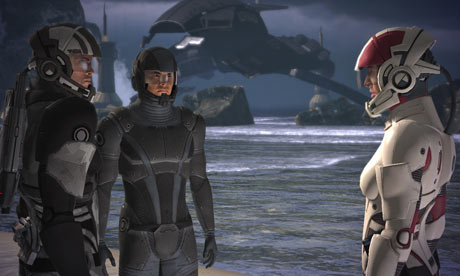
Mass Effect 2, one of the finest games released for the Xbox 360

Was it really five years ago today that British gamers got their hands on the Xbox 360? Apparently so. Too me, it feels like the 360 has been with us for a lot longer. Maybe it's because the original Xbox had such a short lifespan and was clearly – in hindsight – a testbed for the 360. So what are you best memories of the Xbox 360 so far?

For me, the launch itself was mixed. I remember scoffing at Microsoft's claims on how HD would be soon the dominant TV display. Oops. The launch lineup wasn't great either, although Kameo had its moments. Worst of all were the problems with the hardware. Current 360's are very reliable, but my original 360 lasted a few short months and since then I've gone through five – one for every year of the console's life.

Hardware aside, the 360 has delivered some of my finest gaming memories. Mass Effect 1 & 2 have been the highlights, but even on non-exclusive titles the online console experience has – despite the PS3 improving rapidly – almost always been best on the 360. Yes, you have to pay for Xbox Live, but I still think it is worth it.

Then there are achievements and gamerscore. It's fair to say that Microsoft were probably as surprised as anyone as to how popular these elements became. Sony followed suit with Trophies and it's clear that no console in the future will launch without a similar reward system built in.

Anyway, five years on from launch, what are your favourite memories of the Xbox 360 so far?

пятница, 3 декабря 2010 г.

Orchestration 1

Posted by Michael Moyes

Michael Moyes is a Student Advisor at Berkleemusic.com. He finished his studies at Baylor University, where he studied Piano Performance and Business. Michael has performed Piano as a soloist, in a combo, and accompanied by full Orchestra. He is currently working towards his Master Certificate in Arranging and Orchestration from Berkleemusic. You can hear some of Michael’s music on the Berklee Music Network.

What do the films Crimson Tide, Pirates of the Caribbean II, and Inception have in common?


Besides all being scored by Hans Zimmer, they all include elements of MIDI orchestration. MIDI Orchestration is the art of sequencing a piece with virtual instruments with the goal of making it sound like real musicians are performing it.

Since full Orchestras are hard to find (and expensive to hire), I took
 with Ben Newhouse this past Summer term to try and learn how to do this myself.

It quickly became clear that the days of 8 bit midi music a la Super Mario Brothers (NES) are gone; samples are very sophisticated now! When presented with 3 different orchestral audio examples and asked to pick out the one that was created with midi orchestration, I guessed wrong. A bit deflated, I asked around and a couple of my esteemed Berklee colleagues also couldn’t tell which production didn’t have live performers.


The audio samples and DAW technology available today allow composers without the luxury of a full orchestra at their command to compose and produce professional orchestral music. I purchased the East West Gold Symphonic Play Orchestra (at the discounted student rate) and worked with it extensively throughout the 12 week course. Other great libraries like Kontakt, Vienna Symphonic Library, and Garriton Personal Orchestra are also great libraries that can be used in the course. This brings up Ben’s second golden rule of Orchestration…

Rule 2: Use the best samples available.

In MIDI Orchestration, the samples are your performers, and you want performers who will make your music sound great. Mahler’s Symphony No. 3 is a great composition, but it will not sound like one if performed by your local middle school orchestra. Similarly, your latest masterpiece will not sound like a great piece of music if sequenced with the General MIDI bank on an average keyboard.

Just as you aspire for your piece to be performed by the New York Philharmonic, you should aspire for your MIDI orchestrations to be created with the best available samples.”

Orchestration taught me how to effectively write for each section of the orchestra so that my compositions could be played by a true full orchestra or produced digitally using modern technology.

Here is a project of mine so you can get an idea of what you may be creating:

 The course is perfect for students who know how to read/write music and are familiar with using a DAW to sequence their music. Having a love of classical and film music from composers like Bartok, John Williams, Danny Elfman, or anyone else is plus! if you want more information…Berkleemusic’s online winter term begins January 10, 2011.
Find out more at  or contact a Student Advisor:

1-866-BERKLEE (USA) | +1 617 747 2146 (Intl) |


Thanksgiving…. but for what?

By this time, most of you are probably trying to figure out how a 14 pound turkey is supposed to fit into that tiny little browning bag, or you’re stuck in an airport somewhere trying to reunite with a family that will be driving you crazy within about twenty minutes, if you ever do manage to arrive. If so, then the point of Thanksgiving may already be starting to grow a little hazy.

Having spent the last several Thanksgivings in Italy, on a single-minded mission to educate the unknowing locals about the pleasures of this peculiarly American holiday, I know that it can be difficult to explain what this event is all about, especially in times like the present. As one Italian friend asked, “Thanksgiving, yes… I see. But for what? “

With blessings few and far between in the music industry these days, one could be forgiven for focusing solely on football and food on Thursday. Still, particularly in the hard times, one should always be mindful that even the worst of times have their mitigating factors that allow us to survive and fight another day. Well, at least most of us will survive, unless we’re Guy Hands and EMI.

In the spirit of gratitude for past acts of kindness and hope for the future, here are five things for which we songwriters and publishers can thank our lucky stars. Feel free to make your own list, or offer up suggestions—we need all the help we can get.

This year, let’s be thankful for:
 
1. Our Friends
No one survives in this business on his or her own. Not only do we have our own personal networks of contacts, cronies, and colleagues, we are fortunate enough to have dozens of organizations both large and small that support the efforts of songwriters and music publishers. Some go out and get our money for us. Some offer career advice. Some recognize outstanding achievement. Some fight for our rights at a government and industry level. Here’s to the whole lot of helpers: ASCAP, BMI, SESAC, NARAS, NARIP, RIAA, Songwriters Hall of Fame, Songwriters Guild, NMPA, AIMP, etc. If you don’t know what those acronyms stand for, it’s time you do some research. You may be missing out on a valuable ally.
 
2. Little Girls and Old People.
Never thought I’d see this happen, but the truth is that music is no longer a crucial element of youth culture. That spot has been handed over to a whole collection of pastimes from social networking to electronic games. The people keeping us in business these days are adults and their 10-13 year old daughters. Don’t believe me? Go ask Justin Bieber, Taylor Swift, Michael Buble, Susan Boyle, and every top touring act of 2010, almost all of whom are old enough to be Justin Bieber’s grandparent.
 
3. Hipsters, trend-chasers and buzz-mongers.
There’s certainly enough of these people out there. If you haven’t seen ‘em, just go and spend a few days at SXSW, or MusExpo, or check out any edition of Music Week. No matter how many times these characters chase the new trend that never quite catches on, or fork up massive advances to buzz bands that never make it out of Williamsburg, or fill up endless amounts of blog-space waxing on about an act so obscure that it will never be more than a flea on the industry long-tail, they’ll always have a home in a business endlessly devoted to the next big thing.
 
For small independent publishers looking for opportunities, that’s a great thing. Because while the hype-sters and the cooler than thou types are drawing everyone’s attention in one direction, a smart, savvy, and yes, conservative publisher can take his or her pick from dozens of proven, steady income-earners to go in business with. They might be songwriters whose catalogs survive on oldies stations, or heritage acts that sell year after year to their core audience, or jazz, classical and world music acts that barely register on the industry radar screen. They’re not too cool or sexy, and they won’t get you any mentions in the A&R Worldwide newsletter. But they will make you money, and they’re being all but ignored by the A&R staffs of most major music companies. For that, I say thank you.

4. Sub-publishing, if not sub-publishers.
Those of you who follow this blog know that several recent postings have dealt with the opportunities and challenges related to sub-publishing. Like most blessings, this one can also be a bit of a curse. For those looking to spread their business to other foreign territories, the subject of sub-publishing is primarily focused on finding partners in other territories where your music might be effective. That’s an opportunity that often winds up being more of a source for frustration than real income.


The problem is that most sub-publishers are simply not very good. Most companies are simply offering lip-service to foreign publishers—promising to promote their music in the local territory, but rarely doing anything but the most basic collection functions, and sometimes not even that. If you’re counting on your sub-publishers to create a global presence for you, you’re likely to be disappointed.

In fact, the bigger opportunity in regards to sub-publishing is often to become a sub-publisher for other companies. By offering to represent viable catalogs in your local territory, you create a whole new set of business relationships, build your roster without having to make a major financial investment yourself, diversify your song catalog, and improve your cashflow—and that’s not even mentioning the 15-20% that you can often take as your percentage. For a small publisher, picking up other catalogs to sub-publish in your local territory is one of the easiest and most cost-effective business strategies you can hope to find.

5. The suits
And finally, a good word for the lawyers. That’s unusual. However, the truth is that the biggest growth area in the music publishing business for the next 10 years will likely be lawsuits—particularly the large-scale, class action kind. Having already seen distributions from YouTube and Napster cases, and in anticipation of receiving payouts from the late payment fund set up by NMPA as part of the recent negotiations over digital payments from record labels, music publishers are anticipating a windfall. Sooner or later, dozens of major internet media and music businesses will be forced to settle up for music that they’ve been using without a license for the last 5-10 years. It won’t be easy or quick, and it won’t happen without a fight. But given that the copyright laws are clearly on our side, we are likely to eventually walk away with some money, with a little help from our trade organizations, and of course, the lawyers.

I know—it’s not the most uplifting list. Anytime you’re actually thankful for lawyers, lawsuits, trade groups, Justin Bieber and heritage rock acts, you know that it’s been a tough year. Nevertheless, we’re still fortunate to be in a business where we are able to spend our days working with music and songwriters. There are a lot worse ways to make a living.

Most of all, I’m thankful for the indomitable spirit of the Music Business Weasel that lives in all of us. Sure, it’s a business that is often short-sighted, ridiculously speculative, and maybe a little bit sleazy. At the same time, it’s a business of survivors. The people I work with each day are clever, full of ambition, endlessly determined, and always sure that tomorrow will bring the big hit that makes it all worthwhile. That’s the kind of weaseling I most admire, and it’s what assures us that there will always be a music business, in some shape or form, for us to profit from and complain about in the future.

Have a great holiday and thank YOU for your support of the blog over the past 12 months. See you in December!
 

Enter the Blank Realm


I have heard several people complain about this phenomenon of “lo-fi” artists. Why hide songwriting under layers of incoherence, they usually ask, if the songwriting is allegedly good? Being one of the more popular lo-fi examples, Ariel Pink is one of the first examples they use. I then usually ask if them if they have ever heard The Doldrums, his debut full-length. I tell them to name a song on there that would sound “better” if reverted to the studio quality of – say – his most recent album, Before Today. The thing is, Ariel Pink’s style of songwriting at that period – arguably his bleakest and most creative – went hand-in-hand with such an approach, one that gushed with the melancholy and late-night feel of the album with greater authenticity than most artists around. Sure, a more fleshed-out version of any of these songs would still showcase his strengths as a songwriter for any skeptic, but beyond that there is a certain atmosphere embedded in songs written for a more lo-fi method that accommodates the sound beautifully.

Some see it as extraneous novelty when an artist beatboxes his percussion tracks, or when hissing sounds from their mouth serve as prevalent effects. I am not one to buy into novelty effects to disguise poor songwriting either, but if one creates a successful song that would actually benefit from such bizarrely appropriate methods then I do not see the issue. To imagine the muddy desperation of Ariel Pink’s “For Kate I Wait” under the control of an expert percussionist would just not have the same allure to me as the original songwriter finding any method possible to emit his percussion of choice, especially when that original creator did not have the means presently available to him to do otherwise. Call it part of the story and nothing else if you must, but if that overall result produces something that is clearly coherent enough to identify the artist’s intent then complaints are somewhat futile


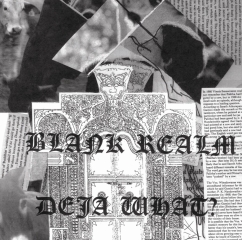
Even to the critics of such labels, the recording style of Australian-based Blank Realm is lo-fi in a rewarding sense. Their methods do not stray too far from what you would expect from financially strapped start-ups. Well, their heavy use of the four-track is somewhat rare in an era dominated by high-tech studio programs, but Blank Realm are no stranger to Pro Tools as well; they will use it if the track calls for it. This is somewhat irrelevant overall though; the recording device at hand is hard to spot because of their muddy sound, which is heavily distorted and sometimes vague but never in excess or over-indulgence. In “Trained Creep”, for instance, there are many different progressions occurring simultaneously, with not one of them demanding more clarity than what is already present. Everything is highly coherent, especially in this awesomely unsettling epic. The varying and indistinguishable methods of recording throughout their second album, Deja What?, enforce my earlier point that distinguishable intent is most essential.

“Trained Creep” is an instrumental effort that shows off the band’s strengths extraordinarily. A distorted effect from the guitar is constant, but there are stabs of icy synths that align with the pit-pattering percussion. The emergence of hazy hi-hats about a minute in is abruptly signaled by the increased presence of the synth, which is presented as a rapid tremolo as the multiple guitar progressions create a swirling effect reminiscent of both post-punk and psychedelia – The Flaming Lips are not too far off, especially their recent Embryonic material. The whole track sounds like one big anxious build-up, which is very exhilarating considering the swelling progressions combine for some wonderful noise that anyone – from psych-rock acts or noise-punk experimentalists – would be proud of.

“Full Moon Door” sounds like it features some of that mouth-beatboxing generally associated with artists like Ariel Pink, who incorporated it with the somber wistfulness of The Doldrums for a very memorable effect. Blank Realm incorporate it with more energy and optimism; the percussion use seems like a fusion of beatboxing and a reverbed hi-hat, but I can’t be certain. Either way, you have to like what they are doing here. A droning organ nearly hides itself in the background over the percussion and its lively progressions subtly serve as the backbone of the track. It is one of several highlights on Deja What?, which is a very impressive sophomore accomplishment for Blank Realm.

Songs about mistakes:readers recommend


Hello each and every one of you. What a week it's been. If you're thinking, "Hang on, didn't we already do songs about arguments?", then award yourself an extra mark because, yes, we did. Forgive me. But taking even the briefest look at this week's responses will have convinced any doubters that there are many songs we never even touched on before. Pop music loves nothing more than a good fight, eh?


Consequently, in the two lists there are as many moments of boiling anger, as there are quiet questions about betrayal and deceit. There are arguments between lovers, families, friends, every bugger's at it, and every bugger thinks the other person is behaving more unreasonably than they are and, therefore, their argument is fundamentally flawed. Human beings are clever like that.


Anyway, the A-list was a fight in itself but it ended up looking like this: The Argument – Ike and Tina Turner; Night of the 4th of May – Al Stewart; I Luv U – Dizzee Rascal; Why – The Byrds; She Said, She Said – The Beatles; Alone in the Make-Out Room – The Broken Family Band; Wasted Words – The Allman Brothers; Explanations – Gil Scott-Heron; Silent Treatment – The Roots; Gerry Rafferty – Whatever's Written in Your Heart.


As far as the B-list, well, here we go:


Family Life – Sham 69

"You bladdy get upstairs and get a wawsh …" Mum argues with son. Son writes a song about his muvver arguing with him all the time. "It's better than getting chucked out," they reason, "it's better than being alone." Well, it is, isn't it?


Dance Music – The Mountain Goats

John Darnielle remembers only too well when, aged 5 ("or 6, maybe") his stepfather starts shouting at his mother and "launches a glass" right at her head and he ran to his room to put on a record to drown out the noise. And that record was, well, "dance music".


The Memory of a Wife – Millie Jackson

Ms Jackson sees an old boyfriend. He tries to pretend he's on top form, she lays into him, describing how his "thing" is "as ragged as a bowl of sauerkraut", while his new love, "done lost her job". Jackson trusts, "you didn't tell her about our love-making …" Astonishing vocal, astonishing track.


Dirty Glass – Dropkick Murphys

This is moronic, but in a good way. I feel like I shouldn't like it, but I've just re-watched that episode of The Wire where they held the whiskey-soaked wake for Ray Cole and I'm kind of in the mood for east coast "Irish" drinking music.


Fighting Talk – Everything But the Girl

Entirely unargumentative music supports a tale of a bitterly contested marriage war. "You slam the door and turn the catch," Tracey Thorn sings, "you turned your home into a prison, conversation into a slanging match …" Literally, ouch.


The Trees – Rush

Alright, so I like Rush a bit. Anyway, this is about an argument in a forest. Or is it? Perhaps it's a rilly, rilly clever allegory that only people wot read books will understand! (I haven't got a clue, sorry.)


Don't Answer the Door – BB King

Mr King is no one's fool. Instead of waiting for his wife to do something so aggravating he has to – has to! – have an argument with her (if not actually smack her legs), he tells her, in no uncertain terms, to not answer the door to anyone, not even her sister (FYI, she talks too much) while he's out mucking about with his pop group. It was acceptable in 1966. Amazing.


Man Next Door – Massive Attack

Horace Andy comes home late – perhaps he's been out for dinner with friends, or at singing at an illegal rave – and his next door neighbour is, as ever, "fussing and fighting", (that's reggae for "arguing"), and he does it "all through the night" to boot. Horrible man. The neighbour, obviously, not Horace.


The Spaniard That Blighted My Life – Billy Merson

Merson should have been as big as Al Jolson. But he wasn't thanks to the latter nicking this song and selling a million copies of it – in 1913, mind – before being sued for copyright infringement by Merson himself. Now that's an argument.


I Hate the Fact That We Breathe the Same Air – Monolithic

No words whatsoever, just nine minutes of freezing cold ultra-metal played by people who appear to be inventing a whole new world of music as they go along. Features a brilliant, fallen-into-the-depths-of-hell breakdown halfway through and a pant-wettingly heavy false ending. Actually mind-warping.


And so to this week's topic, which is, appropriately, mistakes. I'm after songs that are able to look at what's happened, hold up a steady hand and go, "You know what, that was my fault …" Let's hear about some songwriters that are aware of their own mistakes, but also those that can outline and highlight other people's errors and failings. Who's done something they shouldn't have done? Who messed up? Who did something awful they really want to admit to now? Who's got the gumption to turn a mistake into a masterwork? As ever, many extra points will be awarded to well-argued examples. Until next week …

The rulebook:

DO post your nominations before midday on Monday if you wish them to be considered.


DO post justifications of your choices wherever possible.


DO NOT post more than one third of the lyrics of any song.


DO NOT dump lists of nominations – if you must post more than two or three at once, please attempt to justify your choices.


Let's be wonderful to each other – because who knows when it might be your time to trip up?

Have Take That mastered the art of meaningless epic pop?


There comes a time in every boyband's life when they must put away childish things. Childish things such as upbeat, danceable tunes, shaving razors, and lyrics with a recognisable narrative. Instead, they enter the unquestionably adult world of power ballads, facial hair, and lyrics that are little more than strings of vague, pseudo-profound metaphors. That is when they reach for the Deep And Meaningless Pop Epic.
Continue reading...

Every good boyband must eventually perform one, and currently ensconced in the top 10 is a classic example of the DAMPE genre – Take That's vaguely triumphant, vaguely uplifting, utterly indecipherable The Flood. We join them "Standing on the edge of forever, at the start of whatever, shouting love at the world", and then learn that they used to be "cavemen" who beamed at the moon and stars then "forgave them". Which sounds like they've recently been freed from a secure mental health facility rather than premature retirement. More of the same portentous hot air follows: when "thunder turns around" they are "learning how to dance the rain". No, us neither, but of course, big, booming anthems like as this can quite happily succeed solely on the back of buzzwords. Noel Gallagher built a career on such soaring gibberish.


Take That managed the same trick on The Garden (a good portion of all DAMPE song titles include the definite article) from their last album, and although Barlow & co are at an age where such a "mature" approach befits them, it's an age-old pop formula. Indeed, the two boybands who dominated UK pop after Take That's initial split in 1996 both produced textbook examples of the genre. Consider, if you will, Boyzone's philosophical treatise A Different Beat.


"Let's not forget this place," they sang. "Let's not neglect our race. Let unity become, life on Earth be one. So let me take your hand, we are but grains of sand, born through the winds of time, given a special sign." Add an instant-gravitas faux-African choir and some military drumming to decorate their creamy crooning, and you have DAMPE gold.


Their spiritual offspring, Westlife, then took up the same flaming torch with The Rose. "Some say love it is a river that drowns the tender reed," they began, and once they'd thrown in mentions of "flower", "soul", "winter", "dance" and a "road" that is "long", stopped shaving for a few days and made a video in black and white, they could hardly fail.


These songs are invariably ballads, but East 17, as you might expect, were a touch more edgy on Let It Rain: "Make it rough like a chainsaw," rapped Tony Mortimer. "Inject a beat, eat meat like carnivore. Trumpets sound and wrath pours down. Angels dance to the new groove in town." That's right, Tony.


You could date the genesis of the DAMPE back to the days when the Beatles were flexing their intellectual muscles and lesser acolytes were trying desperately to be taken equally seriously (we're duty bound to mention Dave, Dee Dozy, Beaky Mick & Tich's Legend of Xanadu), but the genre had an Indian summer of popularity during the early 80s, when the po-faced pseudery of the new romantics was informing some magnificently pretentious British pop.


And occasionally, they had the style to back up their bluster. Duran Duran accompanied their best tunes with unmitigated nonsense, resulting in Save a Prayer being among the finest DAMPEs ever recorded. With its faintly mystic pan pipe-style motif, and video featuring the band gazing longingly out to an ocean sunset, Save a Prayer pretty much nailed down the DAMPE blueprint.


"Feel the breeze deep on the inside," yearned Simon Le Bon. "Look you down into the well, if you can, you'll see the world in all his fire." Displaying a random-weather-metaphor-generator approach to words that is another DAMPE hallmark, he went on to promise he would "try to hold the rising floods that fill my skin".


Elsewhere, Spandau Ballet were churning out equally silly pop symphonies (remember Musclebound?), and the solo stars were at it too. You may recall Howard Jones's Hide and Seek, or Nik Kershaw's The Riddle. Perhaps you even entered the competition that Kershaw's record label launched to interpret his song's mystical references to "seasons of gasoline and gold". This was without the author's knowledge, by the way, and Kershaw later admitted the lyrics were "nonsense, rubbish, bollocks, the confused ramblings of an 80s pop star". Say it ain't so, Nick.


At least he's part of a noble tradition. You can surely suggest your own nominees for the relatively exclusive but timeless DAMPE canon. Once you've learned to dance in the rain, that is.